
THE ARAVALI U- TURN: A VICTORY TO ECOLOGY
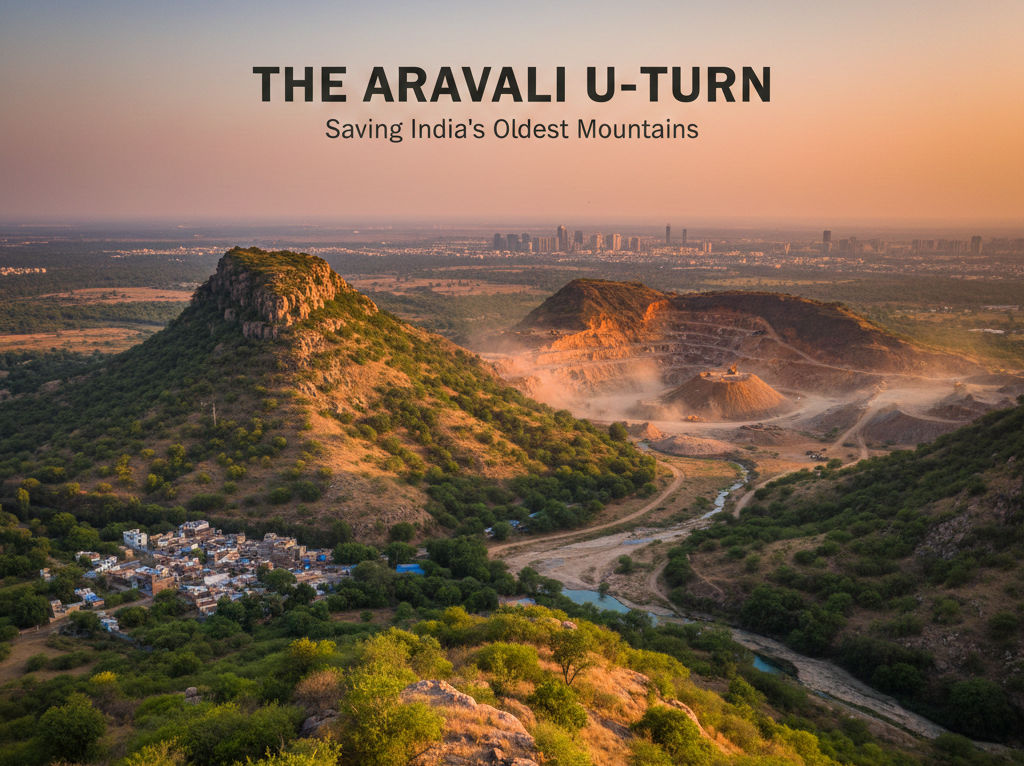
The Aravali Range is not just a collection of rocks; it is the ancient spine of North India. Stretching from Gujarat to Delhi, these hills act as a green shield against the Thar Desert and a vital recharge zone for our dying groundwater tables. However, in late 2025, a legal definition threatened to dismantle this shield forever.
In this post, we dive into the controversial “November Verdict,” the outcry that followed, and the Supreme Court’s recent decision to hit the brakes.
The Verdict That Shook the Ecology (November 20, 2025)
On November 20, 2025, the Supreme Court of India accepted a proposal that sent shockwaves through the environmental community. To bring “clarity” to land disputes and mining leases, the court approved a uniform definition of what constitutes an “Aravali Hill.”
The ruling was based on two rigid mathematical metrics:
- The 100-Metre Rule: A landform would only be legally protected as an “Aravali Hill” if it stood at least 100 metres tall from the ground level.
- The 500-Metre Proximity Rule: For a group of hills to be considered a continuous “range,” the distance between two hillocks could not exceed 500 metres.
At first glance, this seemed like a practical administrative move. State governments in Haryana and Rajasthan had long complained that the lack of a clear definition was stalling infrastructure and mining projects. However, the scientific reality of the Aravalis told a different story.
Why the “Mathematics of 100 Metres” Was Flawed
The Aravalis are among the oldest mountains in the world. Unlike the tall, jagged peaks of the Himalayas, the Aravalis are “relict mountains”—they have been weathered down by wind and water over millions of years.
By setting a 100-metre threshold, the court inadvertently signed a “death warrant” for the majority of the range. According to data from the Forest Survey of India (FSI), nearly 90% of the hillocks in Rajasthan and the Delhi Ridge fall below the 100-metre mark.
Under the November verdict, these “smaller” hills—which still prevent desertification and house wildlife—would have been stripped of their forest protection status, making them legal targets for mining mafias and real estate developers.
The Great U-Turn: The Recent Stay Order (December 2025 – January 2026)
The backlash was immediate. Experts argued that an 80-metre hill provides the same ecological services (like blocking dust storms and recharging aquifers) as a 100-metre hill. Recognizing the gravity of the situation, the Supreme Court, led by CJI Surya Kant, issued a critical stay on December 29, 2025.
The current status of the Aravalis is now defined by these key updates:
- Order in Abeyance: The 100-metre rule has been put on hold. It is no longer the criteria for granting clearances.
- Scientific Re-evaluation: The court has called for a High-Powered Expert Committee composed of independent scientists—not just bureaucrats—to define the range based on ecological significance.
- Total Mining Ban: Until a final decision is reached, there is a complete moratorium on new mining leases or renewals in the Aravali region.
The Road Ahead: January 2026 and Beyond
The next major hearing is scheduled for January 21, 2026. The legal focus has shifted from “administrative ease” back to the Precautionary Principle—the idea that we must protect the environment even in the face of scientific uncertainty.
For the residents of Delhi-NCR, this is more than just a legal debate. If the 100-metre rule had stayed, the “Green Wall” protecting us from the Thar Desert would have developed massive holes, leading to more dust storms, higher temperatures, and a total collapse of the water table.
Conclusion
The Aravalis don’t need a tape measure; they need protection. The Supreme Court’s decision to pause its earlier verdict is a victory for common sense over arbitrary metrics. As we wait for the expert committee’s report, one thing is clear: we cannot value our mountains based on their height alone.
Comments 0